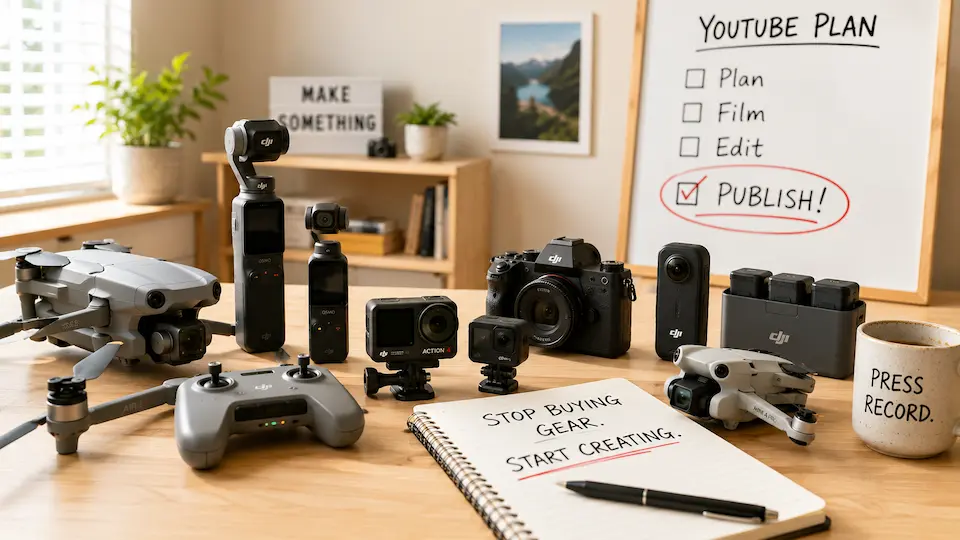
It all started with a drone.
I wanted to make YouTube videos so I bought one. After a week of flying it I convinced myself that I needed a better drone to shoot in a log format, so I upgraded.
I posted a few YouTube videos, but that led to another problem. If I wanted to mix aerial footage with handheld shots, they really needed to match. So I bought a DJI Pocket 3 camera.
Then things escalated.
Flying outdoors is fine, but for indoors you need something smaller. So I bought a DJI Neo drone. Then an action camera seemed reasonable. And another. Before long, I'd managed to acquire almost every camera DJI sells. And key lights for my office because I couldn't shoot a talking head video without them.
The funny thing is that every purchase made perfect sense.
Better image quality. Better stabilisation. More portability. More flexibility when editing.
Each one solved a genuine problem.
The problem was that, whilst my gear collection kept growing, my YouTube channel didn't.
It feels like progress
Buying equipment scratches the same itch as making progress.
You spend hours reading reviews, watching comparison videos, looking at sample footage and convincing yourself that this purchase is the thing that's been holding you back.
It feels productive.
Until you realise that you've spent an entire weekend researching ND filters instead of actually making any videos.
The uncomfortable truth is that buying gear is often much easier than creating something with the gear you already have.
Good tools matter
I'm not trying to pretend that tools don't make a difference. They absolutely do.
It's much easier to play a great guitar than one that won't stay in tune. And it's much easier to crochet with a good hook than a stick. A decent camera is much nicer to use than a terrible one. And a faster computer can save hours of waiting around.
The right tool can make the work easier, more enjoyable and often produce a better result.
There's nothing wrong with buying quality equipment. The problem starts when the next purchase becomes a prerequisite for getting started.
I'll start when I have a better camera.
I'll launch the blog once I've redesigned the website.
I'll build that app once I've upgraded my laptop.
At some point the tool stops removing friction and starts becoming the excuse.
Preparation has a dark side
I've been writing software and leading engineering teams for over 25 years, so I naturally enjoy optimisation. I like systems. I like tools. And I like finding better ways to do things.
Those are useful traits until they become a distraction.
There's a fine line between preparation and procrastination. Learning is valuable. Planning is valuable. Research is valuable.
Better tools can be valuable.
But eventually all of those things become ways of avoiding the only thing that actually matters: doing the work.
This isn't really about cameras
The more I've thought about it, the more I've realised that this pattern shows up everywhere:
- Developers spend weeks choosing a framework before writing any code.
- Founders spend months polishing a logo before talking to a single customer.
- Writers spend hours perfecting their note-taking system instead of writing.
- Musicians buy another plugin before recording their song.
- Engineers debate architecture before they've proved anyone even wants the product
The job title and tools change, but the behaviour doesn't.
Why we do it
Because we're scared.
Buying gear feels safe. Creating something and exposing yourself to judgment doesn't.
Gear can't fail.
You can.
Once you publish something, people aren't judging your camera or your microphone. They're judging your ideas, your storytelling and your creativity. That's a much scarier prospect.
What if people don't like it? What if it isn't very good?
A new camera doesn't tell you that your storytelling needs work. A microphone doesn't tell you that what's coming out of your mouth is boring.
Buying equipment lets us believe the missing ingredient is external.
Creating something forces us to consider the possibility that it isn't.
The irony
The funny thing is that I don't regret buying any of it. I like recording videos. I like flying drones. And I like good tools.
I'm glad I own all of it.
The mistake wasn't buying the gear. The mistake was convincing myself that buying the gear was the same as actually making progress.
It wasn't.
Use what you've got
There comes a point where the quality of the tool stops being the thing holding you back. The next camera won't teach you how to tell a better story, and the next laptop won't write your software.
Better tools reduce friction but they don't create momentum. Eventually you have to stop optimising your setup and start using it.
Press record
I'm writing this as much for myself as anyone else.
In fact, by the time you read this, there's every chance that I've bought another camera. Old habits die hard.
But I'm also hoping that there are videos posted on our new YouTube channel.
Because that's the point.
The next camera won't start the YouTube channel.
The next microphone won't write the script.
The next gadget won't press record.
Only I can do that.